
The Rule of Law, Public Trust, and Civil Discourse
As part of an OBA initiative to take conversation about the significance of the Rule of Law out of the academic and into the everyday, the Honourable Michael H. Tulloch was invited to deliver an address at an event hosted by the Ontario Bar Association and Rotary Club of Toronto. He delivered a powerful address in which he brought into clear focus what the Rule of Law means, why it matters, and where our responsibility to sustain it lies.
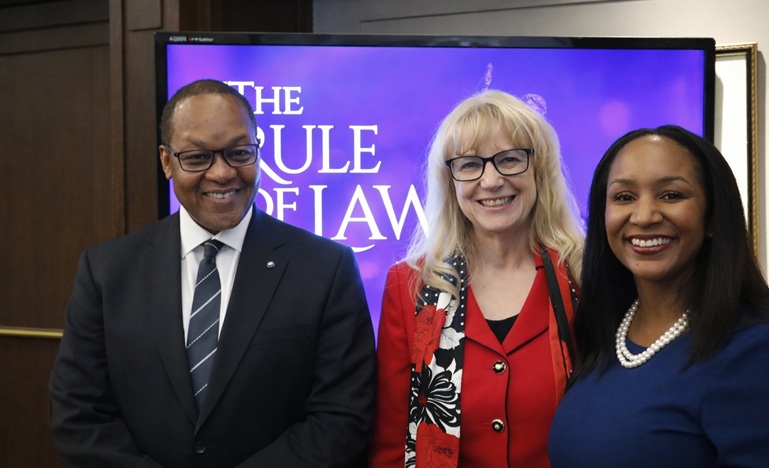
A version of the following remarks was delivered by The Honourable Michael H. Tulloch at the Rotary Club of Toronto on April 17, 2026, where the Chief Justice joined OBA Past-President Lynne Vicars to lead a conversation with community leaders about the importance of the Rule of Law in daily life and a democratic society – part of an ongoing OBA initiative to take discussion of this vital topic out of the academic and into the everyday.
Introduction
Good afternoon and thank you to the Ontario Bar Association, and its President, Katy Commisso, as well as to the president and executives of the Rotary Club (Toronto Chapter) for the invitation to join you this afternoon.
Before I begin, let me ask you to imagine something.
I want you to imagine a small town. At first glance, it looks like any other small town: it has homes, roads, perhaps a school, maybe even a clinic.
But beneath the surface, something essential is missing.
There is no functioning town council to establish clear and consistent rules. There are no reliable legal processes to resolve disputes. There are no lawyers to advise citizens of their rights. There are no police officers to enforce the laws that are made impartially.
And those entrusted with authority act not with integrity, but in their own interests.
In that town, the question is not simply what the law says. The question is whether the law means anything at all.
Such a town is lawless. It exists without the rule of law. This is not merely hypothetical. This state of affairs exists in some countries with extreme forms of authoritarianism or sometimes in what are called “failed states”.
But now imagine something more subtle, and perhaps closer to a more familiar situation.
Imagine that legal and democratic institutions do exist.
There is a municipal government. There are police services. There are school boards. There are courts.
But there is no trust between them. No mutual respect. No shared commitment to the public good.
Instead, each institution criticizes the others – accusing one another of corruption, misuse of power, or acting in bad faith.
A system does not fail only when institutions disappear – it can fail when institutions stop trusting each other and the public, in turn, stops trusting these institutions.
Now add another layer.
There are newspapers. There are radio and television stations. But they do not report the news. They only offer opinions – shaped not by facts, but by what they believe their audiences want to hear.
Over time, they align with particular viewpoints. Audiences fragment. People hear only what reinforces what they already believe. Public trust declines and cynicism grows.
Now add one more element.
There are schools. But civic education is not adequately emphasized. Many students graduate without a meaningful understanding of how their civic and democratic institutions function. They may not fully understand the issues that shape their society or have the tools they need to engage as informed citizens. So, when they reach voting age, they are asked to make decisions without the knowledge needed to make them and without any hope or belief that their voice matters.
And now, consider this.
In that town, individuals still step forward for elected office. But when disagreements arise, instead of debating ideas, people attack each other personally. They turn to the media to further their goals, rather than engaging with each other. They question motives. They target reputations. And participation begins to carry a personal cost.
Now ask: What happens to public debate? What happens to freedom of expression? What happens to leadership?
Because when people fear personal attack, they begin to withdraw. Fewer step forward. Debate becomes polarized. Public trust begins to erode. And people trying to do good for their communities become demoralized and exhausted.
And now, finally, consider one more development.
Individuals arrive in the community from elsewhere. They bring with them hopes for a new life. But they also bring with them a history – perhaps of conflict that did not begin here. They may organize and advocate for people and communities they left behind.
At first, this is a healthy exercise of democratic rights. Ontario, after all, is our most diverse and populous province. It is one of the most diverse communities in the world. Here, we warmly welcome people with diverse viewpoints so that everyone can freely, respectfully, and productively exchange differing and sometimes conflicting points of view This is one of the great benefits of our society and one of the attributes that makes ours a great province to live in.
But over time, without trust in institutions or faith in forums for public discourse, this conflict can become polarizing at the local level. Positions harden, language intensifies, and the community is drawn into division. Institutions are pressured to take sides. Leaders are expected to align. This can further weaken trust in public institutions.
The rule of law depends not only on institutions, but on their perceived legitimacy, and this legitimacy depends on trust. Trust in institutions, trust in information, and trust in each other. Without that trust, even functioning systems begin to weaken.
Without this trust we move, gradually but unmistakably, toward a place where law exists in form, but not in substance.
The rule of law is not sustained by courts alone. It depends on people, leaders in business, in communities, and in public life, who shape how institutions are understood and trusted. When the institutions that support our rule of law are unfairly undermined, they lose their legitimacy and ultimately their effectiveness.
What the Rule of Law Means
At its core, the rule of law means something simple, but profound: No one is above the law and no one is beneath its protection.
It means that governments act according to law.
It means that courts apply the law impartially and independently, based on the evidence brought before them.
It means that power is exercised through rules, not through impulse.
The rule of law provides predictability and security. It provides the ability to invest and plan. It provides confidence that decisions will be made and applied fairly and consistently.
Without it, both economic and social stability begin to weaken.
Why it Matters
Where the rule of law is weak, or where trust in it is eroded, the consequences are immediate. It has economic consequences. Contracts cannot be relied upon. Investment declines. Markets become unstable.
But the deeper impact is on public confidence.
When people lose trust in institutions, they stop relying on them. Disputes move away from lawful processes.
Authority shifts from legitimacy – to influence peddling, coercion, and force. Participation declines. Cynicism grows. Good people disengage.
And when good people disengage, institutions are weakened further.
Judicial Independence & Due Process
The rule of law depends on judicial independence.
Judicial independence is not a privilege for judges. It is a protection for the public. It ensures that decisions are based on law and evidence, not politics, not pressure, and not popularity.
Without that independence, we move closer to that town I described at the beginning of my remarks.
Alongside judicial independence is the need for due process.
Due process is what makes justice possible. Evidence is tested. Arguments are challenged. Decisions are made transparently. Individuals who are accused of or charged with a crime are presumed innocent, until proven guilty in a public court of law.
These safeguards protect against error and abuse of power.
Sustaining the Rule of Law
The rule of law does not prevent conflict; it ensures that conflict does not become chaos. It provides the framework within which even deeply held disagreements can be expressed without undermining the community itself.
In a democratic society, people have the right to express their views. And, in fact, we can and should encourage them to do so. They have the right to protest. They have the right to advocate.
But those rights exist alongside other principles: Public safety, the rights of others, and the need to preserve social order.
So what tools are available to sustain this?
First: clear legal boundaries. Rules governing protest, safety, and conduct.
Second: neutral enforcement. Law applied impartially, without favour.
Third: institutional independence. Resisting pressure to take sides.
Fourth: responsible leadership. Lowering the temperature. Encouraging respectful dialogue. Maintaining focus on principles, not personalities.
Fifth and finally: civil discourse. Because without it, even the best institutions cannot function effectively.
Freedom of Expression and Civil Discourse
Freedom of expression and civil discourse are inter-related.
Freedom of expression is essential. It allows ideas to be debated, institutions to be challenged, decisions to be examined, and for societies to be improved and reformed.
But it depends on responsibility.
When debate becomes personal attack…. when speech deters participation rather than encourages it… the effect is not more freedom. It is less. People withdraw. Leadership declines. Public discourse narrows. And trust erodes.
Freedom of expression flourishes in environments that foster civil discourse. Civil discourse is not ultimately something that can be enforced, but it is something that can be modeled and encouraged.
Closing
The town I asked you to imagine, it is not where we live. But it is not as distant as we might think.
The rule of law does not erode all at once. It erodes gradually, through loss of trust, through breakdown of discourse, and through disengagement.
The rule of law is not sustained by institutions alone. It is sustained by people. By those who lead responsibly. By those who engage respectfully. By those who value truth and fairness.
That town does not emerge only when institutions fail. It can emerge when conflict is allowed to overwhelm them.
And our responsibility is clear: To ensure we never become it.
Thank you.
______________________
Get Involved
The OBA is looking for volunteers to speak to high-school students this fall about what the Rule of Law means. If you are interested in partcipating, please email policy@oba.org.