
“We are Astronauts”: Overcoming Challenges Faced by Women in Legal and Technical Fields
Speaking at the Supreme Court in London, Kristina Milbourn reflects on the various spheres in which women in law and tech are pushing frontiers and offers her advice on how to surmount persistent obstacles in the spaces innovative and intrepid women observe, explore, experience and influence – in a mission to effect meaningful change.
The following remarks were delivered on May 4 at a networking reception at the Supreme Court of London, hosted by ChIPs UK and Germany Chapters, during the International Trademark Association conference.
*****
I am honoured to be here at the Supreme Court in London, in such an important and historic city, speaking to this incredible group on topics that concern and motivate each of us. Women in Law. Policy. Technology. Democracy.
When I was asked to speak about “how can we overcome the challenges we still observe for women in legal and technical fields,” I wasn’t sure I knew the answer. We certainly know there are
challenges in the scarce opportunities and biases that women face when advancing in careers like law and technology; but if I knew the answers – wouldn’t I have implemented them already?
So, I began to reflect on my journey.
Like so many of you who practice intellectual property law, I grew up with a STEM background (i.e. Science, Technology, Engineering, Math). And I became enamoured by STEM fields: life science, ecology, the night sky, the cosmos.
I didn’t know what it was about the sciences and technical fields which excited me, but perhaps I was drawn to the accuracy, the mathematics, the logic of it all. In math, 2+2=4, no matter who is delivering that message. As a woman of colour, as a biracial Black woman, I clung to the idea that science could inoculate me from the cruelty of discrimination.
While this reflection was ongoing, an interesting thing happened. The Artemis II mission to the
moon, was preparing to launch. Like many of you, I found myself caught up in all of the fervour and excitement surrounding the mission. If you don’t know, Artemis II was a NASA mission which culminated last month, and which sent four astronauts to orbit the moon, during which they would travel further in space than any human ever had; and pass by the furtive, dark side of the
moon, which we humans never see when we look up at the night sky, because of a phenomenon known as a tidal lock – it’s hugely esoteric, but just trust me. What’s more, the four astronauts
deployed for the mission included a female astronaut, a Black astronaut, and a Canadian astronaut! So I was hooked.
Wow!! This was incredible. These four phenomenal people were making history. This mission would be their legacy, and I began to envy them!!! They would see things over ten days that the rest of us will never see. They would conduct observations and be accredited to scientific experiments and insights that would solidify their bona fides in scientific communities for all time.
“Why didn’t I become an astronaut?”, I berated myself. The Artemis crew was pushing the boundaries of space! The final frontier!
*****
But wait, I thought. Aren’t I too on a frontier of some sort? For most of my life, like many of you, I have been in the margins. I was among only a few women in my university science labs. I was among only a handful of Black students in my law school. And among many of the institutions I support, I am often the only Black leader.
In looking back, the less and less I saw my peers around me, the more and more I became convinced that maybe I too was pushing a frontier. Aren’t we all, in some way, within the spaces we occupy, spaces which weren’t built for us, breaking new ground?
*****
And not only that, but while on this social-frontier, wasn’t I too, not dissimilar to the Artemis crew, making astute observations and compiling, in my case, an invisible ledger or a knowledge base?
Observing how systemic barriers function to contain equity-deserving groups; Observing how winners and losers are selected;
Observing how opportunism works. But equally:
Observing how to campaign successfully for the outcomes that I’d really like to see; And figuring out how to create meaningful change within the system.
*****
Sometimes when I’m in deep reflection and am seeking to understand what sexism or racism or ableism or bigotry really mean, and what it feels like to be on its receiving end, I conclude with this:
Some people are willing to show the worst side of themselves to you, and only to you, based on what you look like or who they think you are.
Others may have a different take, but I’ve reduced bigotry down that that sentiment.
And in so doing, in unmasking themselves in that way, aren’t they showing you the dark side of the moon? The face that the majority of earthlings never see?
*****
So … If all of those things were true; If I am on a social frontier;
If I am making observations about my truly unique experience in legal and corporate and social life;
And if every now and again, I witness the dark side of the moon …. then … maybe … I’m an astronaut as well …?!?!
In fact, I think we all are. I think we’re astronauts!
*****
So that brings me back to the advice I’ve been asked to impart today. How do we overcome the challenges we still observe for women in legal and technical fields?
Number 1 - We do it by finding meaning in the struggle, and by reframing the struggle. We recognize ourselves as frontier-women and we understand that we are forging a path that hasn’t existed before. We are creating something meaningful which has value, and in creating a more equitable world, we will benefit all of humanity.
Number 2 - We collect and share our findings. We have to be able to intentionally and mindfully observe our experiences – even the painful ones … actually, in fact especially the painful
experiences – and share that knowledge with others. We have to create a whisper-network which alerts our peers:
Who are the prickly personalities? Who are the abusers?
Where are the traps laid?
Useful knowledge must be shared to benefit others, with whom we should not consider ourselves to be in competition. It must be shared without fear that we won’t get ahead.
And when those inevitable “unmaskings” occur, rather than feel a sense of shame about these exchanges, I’m going to suggest to you that you be a scientist. That you see this information as useful intelligence. A data collection. An observation to be shared. In so doing, we can also hold
up a mirror to people whose deeply rooted biases may surprise even them; perhaps giving them a chance to improve in the process.
Number 3 and lastly – We have to Notice the Wonder. We have to acknowledge how special our purpose here is. After all, not everyone qualifies for the mission. Not everyone gets to ride in the space capsule. How lucky we are!
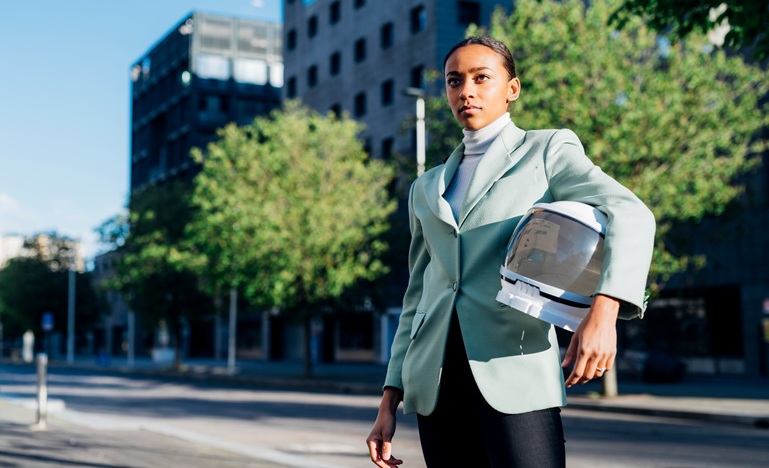
We are on a sacred mission infused with magic, to observe the spaces in which we work and play; notice the fault lines, and then work to democratize opportunities. We are the Artemis crew, within the space shuttle capsule, on a wild ride across the universe, having a completely unique
experience.
And because we have this sacred mission, important to all of humanity, we can learn to withstand the slings and arrows of outrageous fortune, not because they are a distraction to the work we have to do, but in some cases, they are essential to it.
Our mission is significant, and requires bravery, resilience and the pursuit of knowledge. What we are doing isn’t easy; it can feel dangerous at times. But we are doing big, important, meaningful work every day by simply showing up in the spaces we inhabit.
We are here to inspire.