
Supporting Neurodiverse Individuals in the Court System
Going to court is anxiety-inducing for almost anyone. Fears of the unknown, of coming across poorly, of hard-to-follow rules or harsh repercussions frequently plague first-time participants. But for neurodiverse individuals, this anxiety is compounded by particular challenges the justice system presents to those who process information differently. Fortunately, there are systemic changes and supports that can both build inclusion and better accommodate neurodiversity.

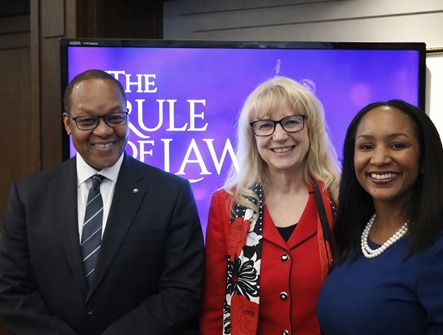
Going to court is an anxiety-inducing prospect for almost anyone. Fears of the unknown, of putting a foot wrong or coming across poorly, of hard-to-follow rules or harsh repercussions frequently plague first-time participants. But for neurodiverse individuals, this anxiety is often compounded by particular or pronounced challenges – in environment, communication and procedure – the justice system presents to those who process and produce information differently. A recent program presented by the OBA’s Access to Justice Committee, chaired by Samantha Green, underscored the systemic change that can build inclusion and accommodate neurodiversity, while offering lawyers practical advice on how to provide pivotal support.
Barriers and Challenges in the Courtroom
While the specifics – in terms of experiences and accommodations – will vary from person to person, Elizabeth Hunter, adult referral and support coordinator at Autism Ontario, identified common types of challenges with which neurodiverse individuals contend in navigating what she calls, “a completely different land.”
For those who love routine – she cites autistic people, as an example – not knowing what to expect can be a tremendous source of anxiety: a slew of new terms, an unfamiliar process and no script to follow. This anxiety can be intense – and exacerbate other issues.
With autistic individuals, Hunter explains, “We talk about ‘spoons’’ – how much energy you have to give to a certain topic or event or social situation.” You only have so many spoons. “That anxiety around being in a courtroom or going through this process may be so overwhelming that problem-solving might not be a function that they’re able to do in the moment,” says Hunter.
Other barriers in the courtroom might include a lack of community – feeling isolated and alone in one’s thoughts; sensory issues – that make loud noises, bright lights or sitting still for long periods difficult; and executive function differences that make meeting deadlines for forms, correspondence or meetings hard to manage.
Meeting Neurodiverse Youth Where They Are: Nevada’s Speciality Courts
Removing or easing these barriers has been the mission of Nevada’s specialty courts, two courts designed specifically to support youth who are neurodiverse: NEAT (Neurodiversity, Education Advocacy, Treatment) Court and DAAY (Detention Alternative for Autistic Youth) Court. And there is much that Ontario can learn from their example of inclusion.
DAAY Court, explains Khristie Cury, coordinator, Nevada DAAY Court and NEAT Court, began with just one youth who needed a calmer courtroom setting where they could avoid sensory overload and get to really understand the process. Once that individual was placed on a quiet afternoon calendar (away from the morning fray), word spread and led to an influx of referrals from probation officers and attorneys on behalf of youth on the spectrum in need of a quieter court space
From that, a bill was signed into a law officially authorizing juvenile courts in Nevada to create programs specifically designed for children diagnosed or suspected of having autism spectrum disorder – a system trauma-informed and developmentally appropriate and responsive to the unique needs of this cohort.
The court – presided over by a judge with extensive training and knowledge of autism and empty but for the key participants – sees one family at a time with a DAAY coordinator in attendance to provide support and explain the process. There are snacks, and fidget toys and different types of decorations, like Star Wars paraphernalia or scenes of Nevada to make youth more comfortable, but the most positive effects are found in the joint commitment to clear setting of expectations and positive reinforcement. “We celebrate even the smallest successes,” says Cury.
This extends to parents when it comes to providing needed documentation, like insurance paperwork. “If the parent gives everything to us in a timely manner, then we also praise the parent in court,” Cury explains. “And we reward them with a Starbucks gift card or something.”
For youth, the biggest incentive for following through, says Cury, is that for most of the cases, if the youth is able to complete the court successfully, their charges are dismissed. “If they are not doing what they are supposed to be doing and they're not wanting to be there, then they go back onto a regular court calendar,” says Cury, “which is longer probation, and they still have to do the same things, but they don't get the support of a court coordinator.”
To qualify for DAAY court, a youth must have an autism diagnosis – but the program has funding to help families obtain testing if autism is suspected. Once a diagnosis is confirmed, explains Cury, the court connects the youth and the family with individualized services, such as applied behavioral analysis, mentorship, pro-social activities and parent training.
To date, DAAY Court has graduated 123 participants with encouraging results. “I’m very proud to say our recidivism rate is only 11 per cent,” says Cury. “So that's a really incredible outcome that demonstrates what can happen when we meet youth where they are and provide supports that makes sense for them.”
DAAY Court and NEAT Court – which was born out of a discovery that some of those referred didn’t have autism but fetal alcohol spectrum disorder or other neurobehavioral disorders that were pre-natal substance related – share the same philosophy: a focus on understanding not punishment; support, not stigma.
“These young people don't need to be fixed, they need environments that recognize how their brain works,” says Cury. “The success of DAAY Court, and now the creation of NEAT Court, show what's possible when the justice system chooses to adapt to the needs of these youth and not make them conform to the court and justice system.”
The Best Approach is Proactive: Ask, Don’t Assume
In the absence of these types of specialty courts or a diagnosis, there is still much that Ontario lawyers can do to identify signs that a client may be neurodiverse or experiencing heightened stress and to alleviate that anxiety or overload.
SF Walker, autism specialist and educator, Autism Ontario, lays out four categories of common triggers:
- Sensory Triggers – like fluorescent lighting, crowded spaces, strong fragrances, buzzing electronics, or echoing chambers;
- Procedural Triggers – such as lack of clear expectations, long waiting times, sudden changes to calendars and schedules, complex paperwork, or unfamiliar jargon;
- Social Triggers – like being cross-examined, feeling interrogated, expectation of eye contact, tone policing, or perceived authority pressures; and
- Emotional Triggers – including past trauma, fear of being misunderstood, or masking fatigue.
Signs that a client is experiencing these triggers might be seen in their movements – fidgeting, avoiding eye-contact, pacing or appearing checked out; in their communication – using a flat tone, delaying responses or shutting down; or behaviour that comes across as uncooperative, evasive or disrespectful, but is a side-effect of attempting to process while overwhelmed.
“A small moment can spiral and derail a case if your clients aren't treated with the care and respect that their systems require,” says Walker. So, the best approach is a proactive one. Walker recommends starting with questions, not assumptions: “Check in with the client and ask how they prefer to communicate.”
Some clients like to receive info verbally, others written; some like bullet points, some big text; some like phone calls, others prefer email.
“How they communicate, how they present, how anxiety presents itself, and what calms them is going to be unique to them,” says Elizabeth Hunter. “So, it's best to ask.”
Other best practices include building predictability with schedules, outlines and regular breaks, and explaining procedures step by step, slowly, using plain language and a warm, calming tone, without talking down to the client. Give them time to process the information you’ve provided.
If a situation does escalate, SF Walker recommends giving both you and the client a pause. “Just remember where this might be coming from and try to clarify what might be needed best in that moment to move forward calmly and smoothly.”
Echoing Cury, Walker notes, “The goal isn't to fix how your client shows up, it's to create a system where they don't have to hide who they are so they can focus on clearer communication and giving you what you need from them.”
The Accommodation Conversation: A Part of Standard Professional Practice
Some lawyers may feel unsure about asking a client if they need accommodations, particularly if the client has not mentioned a need or diagnosis, but having a conversation upfront with every client about what they need to be successful with you is good practice and removes that layer of assumption or awkwardness. “Offering that [should be] a part of standard professional practice; it's not a special exception for anyone,” says Walker.
“An example of a really simple way to ask is by saying something like ‘we try to make sure that our clients can participate as comfortably as possible – are there any adjustments or supports that would make things easier for you during our court meetings or sessions?” Walker says. “This normalizes the question for everyone.”
You might also suggest common types of accommodations, such as written notes after meetings or follow-up phone calls or emails.
Remember, follow-through is key. “When you're asking, it means you're committing to action – if you can't accommodate something directly, just discuss what is possible,” Walker says.
When lawyers approach accommodation conversations with openness and neutrality, it can build trust, reduce client stress and provide a clearer picture on both sides. As Walker says, “The most inclusive lawyers aren't gonna be the ones who have every single answer, they're gonna be the ones who ask the right questions with the most respect.”
********************
Over past year, the OBA Access to Justice Committee has consulted with organizations, including Autism Ontario, ARCH Disability Law Centre and Nevada’s DAAY Court – consultations that have informed several proposals aimed at improving the court experience for neurodiverse people in Ontario. In October, the OBA put forward these proposals in a formal letter to the Chief Justice of the Ontario Court of Justice. The proposals focus on four areas of reform: training and education; physical courtroom environment; inclusive language and communication; and technology use. The Committee has been selected to present on Supporting Neurodiversity in the Court System at the 2026 NAC Conference.
Look for an OBA CPD program in spring 2026 offering best practices for lawyers in supporting neurodiverse clients.
View OBA's program Supporting Neurodiverse Individuals in the Court System on demand.