
Panoramic Views from a Private to In-House Practice Roundtrip
An internationally trained lawyer who has made the transition from private to in-house practice and back again, Lotus Menezes shares best-of-both-worlds advice from a career journey crossing jurisdictions, industries and areas of law, shaped by a steadfast professional community.

My legal career has taken me across jurisdictions, industries, and professional identities private practice in Tanzania and South Africa, an in-house role at Barrick Mining Corporation, to private practice in Canada and now to setting up my own professional corporation, as an internationally trained lawyer. Each chapter has expanded my understanding of what legal work truly is, how business decisions are made, and what clients genuinely need. But one constant in my Canadian journey has been the support and community of the Ontario Bar Association, particularly the In-House Lawyers Section, which has given me a platform not just to learn, but to contribute.
I began practicing law in Tanzania, where versatility is not optional, it is a professional necessity. The work spanned corporate, commercial, employment, and regulatory matters, often in fast-changing environments. My early years taught me to think on my feet and to bridge gaps between legal theory and practical commercial realities. Moving to Johannesburg to join Webber Wentzel deepened my exposure to complex transactions and the fast pace of private practice in a competitive African business hub. It was there that I refined the discipline, precision, and client-centric approach that have shaped me ever since.
When I moved to Canada and joined Barrick Mining Corporation as in-house counsel, everything changed. Suddenly, I wasn't just advising on, I was part of the decision-making. Being embedded within a global mining business sharpened my understanding of risk, strategy, and the non-legal pressures that shape corporate choices. I learned that in-house lawyers must be translators: converting legal frameworks into operational guidance, aligning competing priorities, and helping teams move projects forward in real time. It is a role that requires technical confidence but also empathy, pragmatism, and the courage to offer clear positions.
Returning to private practice in Canada, I found myself drawing constantly on both worlds. I know the expectations of in-house teams: the need for concise answers, commercially oriented advice, and collaboration rather than academic analysis. I know what external counsel can do to support, accelerate, or unintentionally slow down a transaction. And I understand that good advice only matters if a business can actually implement it.
This perspective is also why my involvement with the OBA In-House Lawyers Section has been so meaningful. The Section brings together a diverse group of lawyers working inside corporations, public institutions, and not-for-profits, each navigating the unique pressures of balancing legal integrity with organizational objectives. Through this community, I have seen firsthand how shared experiences can elevate the profession.
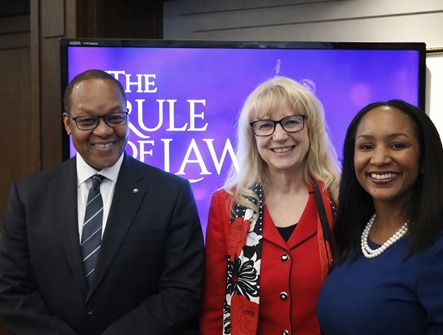
Recently, I had the opportunity to moderate a panel for the OBA In-House Lawyers Section that brought together senior in-house counsel and external litigators to discuss how to work more effectively across these two roles. The conversation highlighted key themes that resonated with me:
Partnership, not silos.
In-house counsel want external partners who understand the business model, risk appetite, budget realities, and internal processes. Litigators emphasized that effective collaboration is grounded in clarity on timelines, expectations, and what the business is truly trying to achieve.
Communication is the strongest tool in both litigation and corporate work.
The panel highlighted that “over-communicating” is rarely a problem; under-communicating often is. Keeping each other aligned can dramatically reduce costs and prevent missteps.
External counsel must deliver actionable advice, not academic memos.
This insight echoes my own experience at Barrick. Businesses want solutions that tie directly to operations, timelines, and strategy. The best external counsel know how to translate complexity into clarity.
In-house counsel carry invisible pressures.
Panelists spoke openly about managing internal stakeholders, preserving budgets, and balancing competing priorities all while ensuring legal compliance. It requires diplomacy, courage, and strategic thinking.
Moderating that discussion reaffirmed for me why the OBA In-House Counsel Section is such a valuable professional community. It creates space for honest conversations about what actually works, what doesn’t, and how we can bridge gaps between in-house and external perspectives. It is a forum where internationally trained lawyers, like myself, can share global insights while learning from Canadian corporate leaders.
Now as I branch out on my own, exploring and building on corporate commercial practice, I am learning that the legal landscape is evolving, there are different ways to practice that do not necessarily confine us to the same historical structures of the legal field. The legal landscape is shifting, reduced budgets and redefined mandates mean that the traditional molds are being challenged in many ways. the lessons from both sides and the continued engagement through the OBA shape how I approach every file. Seeing the legal profession from both vantage points has taught me that strong relationships, thoughtful communication, and a deep understanding of business strategy will always matter more than the length of any memo. The OBA In-House Lawyers Section reinforces this truth daily, by connecting us, challenging us, and reminding us of the shared commitment that underpins our profession.